LLM Automation Stack: What to Implement First Most companies do not fail with LLM automation stack and what to implement first because the technology is weak. They fail because execution is fuzzy, ownership is split, and measurement starts too late. The practical path is straightforward: define the operating problem in business terms, assign one accountable owner, constrain the first release, and instrument outcomes from day one. If you are responsible for delivery, you need an operating article rather than a trend summary. This playbook is written for that reality. It assumes teams are busy, systems are imperfect, data quality is mixed, and leadership still expects measurable progress within a quarter. The first decision is not which model or vendor to buy. The first decision is where process friction is concentrated enough that improvement becomes visible in weekly metrics. When you choose a workflow with recurring volume and repeated handoffs, gains compound quickly and survive leadership scrutiny.
Execution blueprint for teams that need results this quarter
For LLM automation stack and what to implement first, your first release should be narrow enough to run within 30 to 45 days, yet meaningful enough to affect a metric leaders already track. This keeps sponsorship active and gives delivery teams space to harden the system before broader exposure. Implementation detail matters at the interface boundary. Define exactly where data enters, how it is normalized, which fields are mandatory, and how failures are surfaced to users. Vague integration assumptions are a top-three cause of pilot delays. Document owner decisions in plain language: why this rule exists, when it can be bypassed, and who approves changes. Decision logs reduce institutional memory loss and make onboarding faster when teams rotate responsibilities.
Start with the workflow economics, not the tool catalog
Map the workflow from intake to completion and count where work waits. Delay is usually created by queue ambiguity, manual re-entry, and exception handling that has no clear owner. Each delay point should be measured in hours and in cost of delay, not just in anecdotal frustration. A reliable baseline has five numbers: volume per week, median cycle time, rework rate, escalation rate, and customer-visible error rate. Without these numbers, any pilot can look successful because there is no denominator. With these numbers, you can defend investment decisions and stop low-value experiments quickly. In one professional-services team, proposal preparation averaged 14 business days because analysts manually stitched prior language and compliance notes. After introducing retrieval with approved clauses and a guided drafting step, cycle time dropped to 8 days while compliance corrections declined by 37 percent. The visible win came from process design, not model novelty.
Build a delivery lane that survives real operations
A production lane needs explicit boundaries: what the system will automate, what it will recommend, and what must remain human-approved. Teams that skip this boundary design create hidden risk and eventually lose trust when one edge case causes an avoidable incident. Use staged confidence thresholds. High-confidence low-risk tasks can be auto-completed, medium-confidence tasks should be routed with suggested actions, and low-confidence outputs must be blocked and escalated. This policy structure gives teams speed without pretending uncertainty does not exist. Treat exception handling as a first-class product requirement. Every exception should capture cause, route, owner, and closure time. Exception data is your fastest path to quality improvement because it reveals where prompts, retrieval, data mapping, or policy assumptions are breaking under operational pressure.
Define governance as a weekly operating rhythm
Governance is not a quarterly slide deck. It is a recurring operating rhythm where product, engineering, security, and business owners review incidents, drift indicators, blocked work, and planned changes. Weekly cadence prevents risk accumulation and keeps delivery velocity intact. The minimum governance packet should include output quality trend, override frequency, policy violations, unresolved exceptions, and customer impact notes. Keep it short, evidence-based, and tied to decisions. If a metric does not influence a decision, remove it. When teams adopt this rhythm, approvals become faster because stakeholders see evidence continuously instead of being surprised at release gates. In practice, this shortens compliance conversations and reduces late-stage rework that destroys delivery confidence.
Instrument adoption and behavior, not just model accuracy
Many teams celebrate benchmark scores while users quietly bypass the system. Operational adoption depends on whether the assistant or automation reduces cognitive load in the exact moment a decision is made. Instrument usage depth, assisted completion rates, and manual fallback reasons. Create a role-specific success view. Executives need throughput and risk indicators, team leads need queue and exception pressure, and frontline staff need response quality and handoff clarity. One dashboard cannot satisfy all three audiences, so build tiered reporting intentionally. In a support environment, introducing assisted summaries improved first-response time only after teams redesigned ticket templates to fit the new workflow. Before template redesign, the model was accurate but adoption stalled because agents still needed extra clicks and manual formatting.
Scale through reusable patterns, not one-off heroics
After the first workflow stabilizes, package what worked: guardrail patterns, prompt libraries, evaluation harnesses, integration adapters, and rollout checklists. Reuse shortens future delivery cycles and prevents every team from relearning the same expensive lessons. Create a prioritized expansion queue scored by business impact, implementation complexity, data readiness, and risk class. This queue should be reviewed monthly with finance and operations present. Cross-functional scoring prevents politically popular but low-return initiatives from consuming scarce engineering capacity. A disciplined scaling model usually adds two to four workflows per quarter with higher reliability than broad unfocused launches. The point is not maximum pilot count. The point is sustained business value with manageable operational risk.
90-day implementation sequence
Weeks 1 and 2 should focus on scope control and baseline capture. Freeze success metrics before any prompt tuning starts. Teams that change metrics midstream lose comparability and trigger avoidable stakeholder disputes. Weeks 3 and 4 should deliver a working thin slice connected to live but limited data. Do not wait for perfect integration. Use constrained production exposure and collect error classes aggressively. Weeks 5 and 6 should prioritize exception pathways, approval logic, and auditability. This is where most pilots either mature into operations or collapse under edge-case load. Weeks 7 and 8 should harden reporting, role-based permissions, and rollback procedures. Reliability is operationally defined by how quickly teams can detect and recover from bad outputs. Weeks 9 and 10 should expand controlled adoption to additional users while comparing cohort performance against baseline. Expansion without cohort comparison hides degradation. Weeks 11 and 12 should finalize scale/no-scale decision packets with financial impact, risk profile, and required platform investments. Decisions should be evidence-led, not enthusiasm-led.
Common failure modes and direct countermeasures
Failure mode: leadership asks for enterprise rollout before one workflow is stable. Countermeasure: enforce a readiness gate requiring sustained performance over at least four operating weeks. Failure mode: teams optimize prompt quality but ignore upstream data defects. Countermeasure: implement schema validation and data quality alerts before broad user onboarding. Failure mode: no one owns the business process after go-live. Countermeasure: assign a process owner with authority over policy, exception budgets, and SLA trade-offs. Failure mode: legal and security reviews happen only at launch. Countermeasure: include both functions in weekly operating reviews with pre-agreed control evidence templates. Failure mode: teams claim time savings but cannot tie them to throughput or revenue. Countermeasure: connect operational metrics to financial reporting definitions used by finance.
What an LLM automation stack actually means in operations
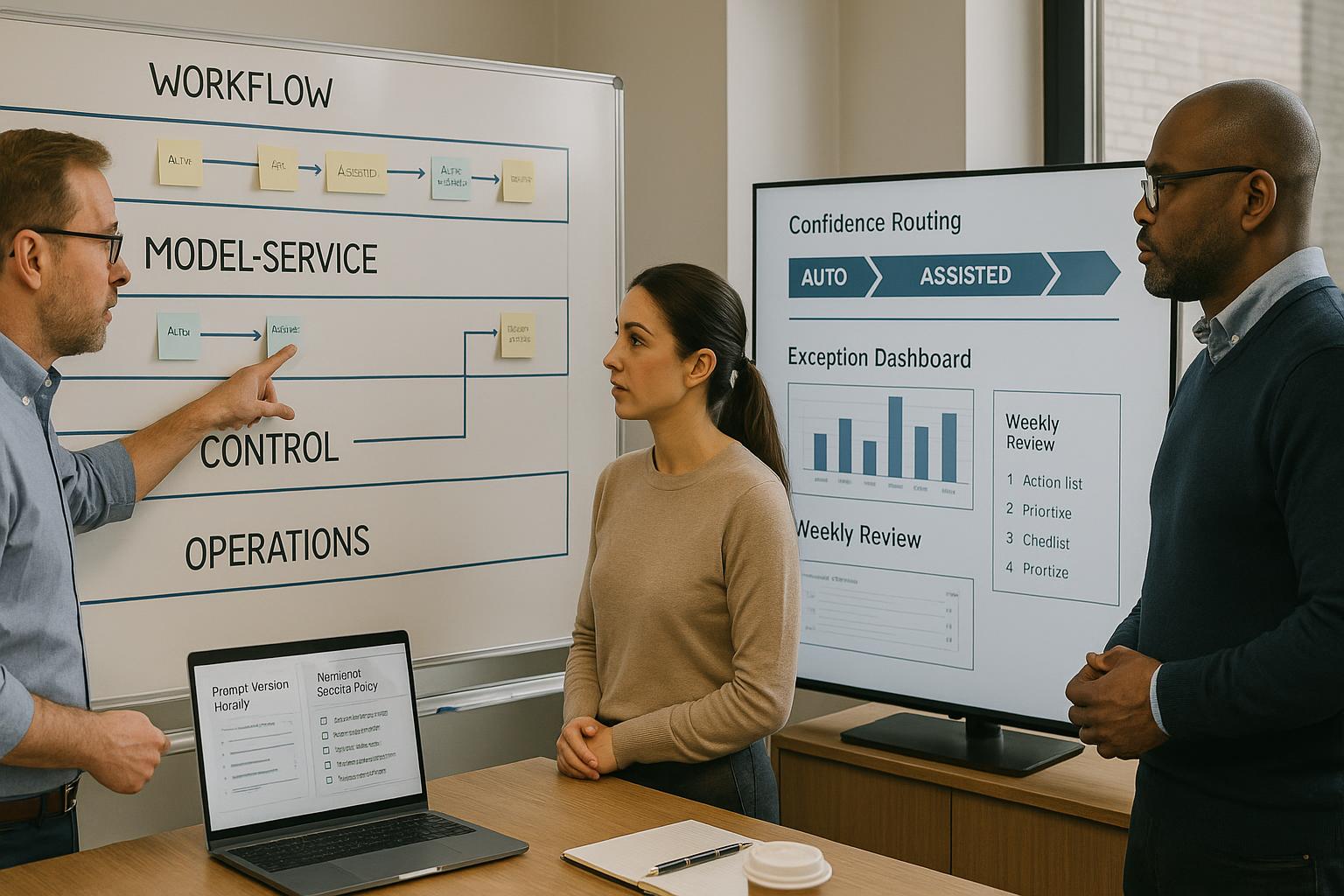
Teams often talk about an "LLM stack" as if it were a vendor selection exercise. In real operations, the stack is a control system for how language models touch workflow. If you cannot explain where model output is generated, validated, approved, and logged, you do not have a stack. You have a demo. I define the stack in four practical layers: workflow layer, model-service layer, control layer, and operations layer. Workflow layer maps where value is created in business process. Model-service layer manages prompts, retrieval, and model calls. Control layer handles policy gates, confidence routing, and human approvals. Operations layer tracks health, drift, and incident response. This framing helps teams avoid building fragile one-off automations that break on first scale attempt. The first implementation mistake is trying to automate end-to-end in month one. Start with one bounded lane where value and risk are both visible. A narrow successful lane teaches architecture habits that can be reused across future workflows.
Layer 1: workflow-first design before model decisions
Pick one recurring workflow with measurable friction. Good candidates include intake triage, proposal drafting support, knowledge retrieval for support teams, and internal summary generation for handoffs. Weak candidates are novelty tasks with low volume or unclear ownership. Volume and ownership are what make automation improvements durable. Map the current flow in practical terms: input source, transformation steps, decision points, output destination, and escalation routes. For each step, label whether the model should generate, classify, summarize, or abstain. This simple map prevents model sprawl and keeps automation behavior aligned with real process constraints. Define non-automated boundaries early. If compliance, contractual language, or customer commitment is involved, require human approval until quality evidence supports controlled relaxation. Teams that skip this boundary work often create avoidable governance friction later.
Layer 2: model-service architecture that stays replaceable
Model-service design should prioritize replaceability over novelty. Wrap model calls behind internal service contracts so prompt logic, provider settings, and retrieval configuration are decoupled from workflow code. This protects you from provider shifts, pricing changes, and capability regressions. Keep prompt assets versioned with change rationale. When output quality changes, you need to know whether cause came from prompt edits, context retrieval drift, or model behavior updates. Without versioned prompts and run metadata, diagnosis becomes guesswork. Use retrieval with strict source boundaries. Retrieval should pull from approved content classes and log citation context for auditability. Free-form retrieval across noisy repositories can improve apparent fluency while degrading factual reliability in business-critical outputs.
Layer 3: control plane with policy gates and confidence routing
The control plane is where operational trust is built. Implement rule-based gates before broad rollout: input validation, output policy checks, confidence bands, and consequence-based routing. High-confidence low-risk outputs can be automated. Medium-confidence outputs should be assisted. High-consequence outputs should require approval even at high confidence. Tie controls to consequence, not to model enthusiasm. A summary typo and a contractual error do not have equivalent impact. Your routing policy should reflect that directly. This is one of the fastest ways to reduce risk without killing throughput. Log every control decision path. When incidents happen, teams need to reconstruct whether failure was caused by source data, retrieval choice, prompt instruction, model response, or policy routing. Rich control logs shorten incident resolution and improve future guardrails.
Layer 4: operations plane for reliability and improvement cadence
Automation stacks fail quietly when operational monitoring is shallow. Track not only uptime, but also acceptance rate, override reasons, abstain rate, exception volume, and time-to-recovery after control failures. These indicators reveal whether the stack is reducing operational load or shifting it to hidden manual cleanup. Run a weekly operations review with fixed inputs: top failure classes, unresolved exceptions, cost trend, quality trend, and pending control adjustments. Keep outputs strict: approved changes, deferred changes with reasons, and owner assignments with due dates. Include a monthly resilience drill for one realistic failure mode, such as retrieval source outage or policy gate regression. Rehearsal quality is often the difference between a contained incident and a customer-visible cascade.
Implementation sequence: what to build first in 30-60-90 days
Days 1-30: workflow selection, baseline metric capture, control policy draft, and thin model-service wrapper. Ship one constrained lane to a small cohort and capture all overrides with reason codes. Days 31-60: stabilize retrieval quality, refine confidence routing, and harden logging/audit pathways. Introduce role-based dashboards for operators and managers. Do not expand lane count before exception trend improves. Days 61-90: scale to one or two adjacent lanes using reusable control and service components. Tie scale decisions to metric thresholds (acceptance rate, SLA impact, and unresolved exception backlog), not to subjective optimism. This cadence is intentionally conservative. It protects quality while still delivering measurable progress each month.
Prompt operations and evaluation discipline
Prompting in production is an operational practice, not creative writing. Keep prompts short, explicit, and schema-aware. Reference field names, policy terms, and expected output structures directly. Ambiguous prompt language creates unstable behavior across similar requests. Evaluate prompts with representative samples from real workflow, not idealized examples. Include hard cases: incomplete inputs, contradictory context, policy conflict scenarios, and edge-case formatting. If a prompt only works on happy-path examples, it is not production-ready. Track evaluation outcomes over time and connect them to release notes. This creates organizational memory and prevents repeated regressions when teams rotate.
Cost governance: avoid silent automation debt
An LLM stack can look productive while accumulating hidden cost through token usage, manual review burden, and correction overhead. Track three cost layers: direct runtime cost, human intervention cost, and reliability maintenance cost. If you only track runtime, ROI will look artificially strong and later fail under scrutiny. Set monthly guardrails for each lane: maximum spend, maximum override ratio, and maximum unresolved exception carryover. If two guardrails fail for two consecutive weeks, pause expansion and run stabilization. This protects both budget and team trust. Also track cost per completed useful outcome, not cost per request. Outcome-based costing aligns stack decisions with business value instead of raw activity volume.
Failure patterns and countermeasures
Pattern: teams deploy one model endpoint for every workflow. Countermeasure: establish shared service wrapper and lane-specific policies. Pattern: retrieval quality degrades silently as content grows. Countermeasure: source curation ownership, freshness checks, and retrieval drift alerts. Pattern: automation reduces visible latency but increases hidden correction load. Countermeasure: include override and rework metrics in core dashboard. Pattern: security/compliance joins only at launch. Countermeasure: include both in weekly control review with predefined evidence templates. Pattern: scale decisions are driven by enthusiasm. Countermeasure: use threshold-based expansion gates tied to operational metrics.
A practical checklist for your next 10 working days
Day 1: choose one workflow lane and baseline metrics. Day 2: publish stack layer map (workflow, model-service, control, operations). Day 3: define confidence routing and human-approval boundaries. Day 4: implement model-service wrapper with versioned prompt assets. Day 5: deploy thin slice to constrained cohort. Day 6: capture overrides and exception taxonomy. Day 7: run weekly control review and approve top three fixes. Day 8: publish cost snapshot with three-layer model. Day 9: run one resilience drill scenario. Day 10: decide expand vs stabilize using hard thresholds. If this checklist is not complete, avoid adding new lanes. Build reliability muscle first, then scale.
Executive stack review template for monthly steering
Section one: lane performance (acceptance, override, SLA impact, cycle-time movement). Section two: risk/control state (policy violations, unresolved exceptions, audit readiness). Section three: cost layers (runtime, human intervention, maintenance). Section four: recommendation with one scale decision, one stabilization decision, and one governance decision. End with one plain-language value statement tied to business outcomes. For example: "Proposal lane reduced median turnaround by 31% while keeping compliance correction rate below threshold." Clear statements maintain sponsorship and keep strategy anchored to results.
How to implement without enterprise-complexity traps
The phrase "without enterprise complexity" does not mean without discipline. It means you avoid architecture and governance overhead that does not improve outcomes in your current maturity stage. Early-stage teams should prioritize controls that directly reduce operational risk and improve decision speed, while postponing broad platform ambitions that consume time without immediate value. Start with one workflow, one queue, one policy set, and one reporting surface. Resist the urge to build a universal orchestration framework before proving a lane. A lot of teams burn two quarters designing abstract automation platforms and still have no measurable throughput improvement. Practical stacks prove value first, then generalize. Use "thin but strict" implementation choices. Thin means minimal moving parts. Strict means clear boundaries, logging, and ownership. You can run this model with existing queue tools, lightweight service wrappers, and focused review cadence. You do not need a giant platform team to create reliable automation behavior.
Role design for a small high-performing automation team
A lean stack can run effectively with four core roles. Process owner defines business policy and success thresholds. Automation lead owns service behavior and release sequencing. Data/context owner manages source quality and retrieval boundaries. Control owner manages policy gates, exceptions, and audit evidence quality. One person can hold multiple roles early, but every role must be explicit. Define backup ownership from day one. Automation incidents rarely happen at convenient times, and single-person ownership is fragile. Backup owners should be able to interpret logs, apply safe rollback, and communicate impact clearly. This is basic resilience, not luxury staffing. Also set a communication contract: who informs operators, who informs leadership, and who informs clients when relevant. Incident communication failure often causes more damage than the initial model error.
Integration minimalism: connect only what improves decisions
Do not integrate every system just because APIs exist. Integration should follow decision value. If a source does not materially improve output quality or reduce cycle time, keep it out of phase one. Extra integrations increase failure surface and delay stabilization. Use one authoritative identifier for each workflow object and propagate it across logs and events. This makes traceability feasible even in small stacks. When teams skip identifier discipline, root-cause analysis becomes expensive and often inconclusive. Apply asynchronous processing for non-blocking tasks and synchronous flows only where user-facing latency matters. This reduces brittle coupling and keeps failure behavior predictable. Lightweight architecture choices like this create major reliability gains without complex infrastructure.
Security and compliance controls you should not postpone
Even in low-complexity rollouts, some controls are mandatory: input sanitation, output policy filtering, prompt injection defense patterns, access boundaries on sensitive data, and audit log retention for high-impact actions. These controls can be implemented simply but cannot be skipped. Define restricted content classes early. If sensitive legal, financial, or personal data can appear in prompts or outputs, set explicit handling rules and review pathways. "We will harden later" is one of the most expensive promises in automation programs. Run periodic red-team micro-tests on real workflows. You do not need a huge security exercise every week. Two focused abuse simulations per month are enough to reveal weak points and keep defenses current.
When to expand lanes and when to hold
Expand only when three conditions are met for at least one full month: acceptance rate stable above target, unresolved exceptions trending down, and business outcome metric clearly improved. If one condition is weak, hold and stabilize. Growth without stability creates visible quality swings and management distrust. When expanding, reuse controls and templates aggressively. New lane should inherit prompt governance, evaluation harness, logging schema, and review cadence from previous lane. Reinventing these basics for each lane wastes time and increases inconsistency risk. If expansion pressure comes from leadership urgency, offer a staged compromise: one new lane in observation mode with strict fallback to human handling. This allows momentum without exposing clients or operations to uncontrolled risk.
A realistic maturity path over three quarters
Quarter one should establish one reliable lane with clear controls and evidence. Quarter two should add adjacent lanes using the same governance skeleton and improve cost efficiency through reuse. Quarter three should optimize portfolio balance: stop weak lanes, scale strong lanes, and reduce intervention burden through targeted control improvements. This maturity path is more valuable than a fast but unstable rollout. It builds organizational confidence and creates a foundation that can survive staffing changes, provider shifts, and new compliance requirements. By the end of this path, your team should be able to answer three hard questions confidently: where value is created, where risk is controlled, and where scaling will pay back fastest. If those answers are still fuzzy, continue stabilization before adding complexity. ---BODY_END--- ===ARTICLE_END===