GenAI Ops Priorities: Security, Resilience, and Customer Experience First Most companies do not fail with GenAI ops priorities: security, resilience, and customer experience first because the technology is weak. They fail because execution is fuzzy, ownership is split, and measurement starts too late. The practical path is straightforward: define the operating problem in business terms, assign one accountable owner, constrain the first release, and instrument outcomes from day one. If you are responsible for delivery, you need an operating article rather than a trend summary. This playbook is written for that reality. It assumes teams are busy, systems are imperfect, data quality is mixed, and leadership still expects measurable progress within a quarter. The first decision is not which model or vendor to buy. The first decision is where process friction is concentrated enough that improvement becomes visible in weekly metrics. When you choose a workflow with recurring volume and repeated handoffs, gains compound quickly and survive leadership scrutiny.
Execution blueprint for teams that need results this quarter
For GenAI ops priorities: security, resilience, and customer experience first, your first release should be narrow enough to run within 30 to 45 days, yet meaningful enough to affect a metric leaders already track. This keeps sponsorship active and gives delivery teams space to harden the system before broader exposure. Implementation detail matters at the interface boundary. Define exactly where data enters, how it is normalized, which fields are mandatory, and how failures are surfaced to users. Vague integration assumptions are a top-three cause of pilot delays. Document owner decisions in plain language: why this rule exists, when it can be bypassed, and who approves changes. Decision logs reduce institutional memory loss and make onboarding faster when teams rotate responsibilities.
Start with the workflow economics, not the tool catalog
Map the workflow from intake to completion and count where work waits. Delay is usually created by queue ambiguity, manual re-entry, and exception handling that has no clear owner. Each delay point should be measured in hours and in cost of delay, not just in anecdotal frustration. A reliable baseline has five numbers: volume per week, median cycle time, rework rate, escalation rate, and customer-visible error rate. Without these numbers, any pilot can look successful because there is no denominator. With these numbers, you can defend investment decisions and stop low-value experiments quickly. In one professional-services team, proposal preparation averaged 14 business days because analysts manually stitched prior language and compliance notes. After introducing retrieval with approved clauses and a guided drafting step, cycle time dropped to 8 days while compliance corrections declined by 37 percent. The visible win came from process design, not model novelty.
Build a delivery lane that survives real operations
A production lane needs explicit boundaries: what the system will automate, what it will recommend, and what must remain human-approved. Teams that skip this boundary design create hidden risk and eventually lose trust when one edge case causes an avoidable incident. Use staged confidence thresholds. High-confidence low-risk tasks can be auto-completed, medium-confidence tasks should be routed with suggested actions, and low-confidence outputs must be blocked and escalated. This policy structure gives teams speed without pretending uncertainty does not exist. Treat exception handling as a first-class product requirement. Every exception should capture cause, route, owner, and closure time. Exception data is your fastest path to quality improvement because it reveals where prompts, retrieval, data mapping, or policy assumptions are breaking under operational pressure.
Define governance as a weekly operating rhythm
Governance is not a quarterly slide deck. It is a recurring operating rhythm where product, engineering, security, and business owners review incidents, drift indicators, blocked work, and planned changes. Weekly cadence prevents risk accumulation and keeps delivery velocity intact. The minimum governance packet should include output quality trend, override frequency, policy violations, unresolved exceptions, and customer impact notes. Keep it short, evidence-based, and tied to decisions. If a metric does not influence a decision, remove it. When teams adopt this rhythm, approvals become faster because stakeholders see evidence continuously instead of being surprised at release gates. In practice, this shortens compliance conversations and reduces late-stage rework that destroys delivery confidence.
Instrument adoption and behavior, not just model accuracy
Many teams celebrate benchmark scores while users quietly bypass the system. Operational adoption depends on whether the assistant or automation reduces cognitive load in the exact moment a decision is made. Instrument usage depth, assisted completion rates, and manual fallback reasons. Create a role-specific success view. Executives need throughput and risk indicators, team leads need queue and exception pressure, and frontline staff need response quality and handoff clarity. One dashboard cannot satisfy all three audiences, so build tiered reporting intentionally. In a support environment, introducing assisted summaries improved first-response time only after teams redesigned ticket templates to fit the new workflow. Before template redesign, the model was accurate but adoption stalled because agents still needed extra clicks and manual formatting.
Scale through reusable patterns, not one-off heroics
After the first workflow stabilizes, package what worked: guardrail patterns, prompt libraries, evaluation harnesses, integration adapters, and rollout checklists. Reuse shortens future delivery cycles and prevents every team from relearning the same expensive lessons. Create a prioritized expansion queue scored by business impact, implementation complexity, data readiness, and risk class. This queue should be reviewed monthly with finance and operations present. Cross-functional scoring prevents politically popular but low-return initiatives from consuming scarce engineering capacity. A disciplined scaling model usually adds two to four workflows per quarter with higher reliability than broad unfocused launches. The point is not maximum pilot count. The point is sustained business value with manageable operational risk.
90-day implementation sequence
Weeks 1 and 2 should focus on scope control and baseline capture. Freeze success metrics before any prompt tuning starts. Teams that change metrics midstream lose comparability and trigger avoidable stakeholder disputes. Weeks 3 and 4 should deliver a working thin slice connected to live but limited data. Do not wait for perfect integration. Use constrained production exposure and collect error classes aggressively. Weeks 5 and 6 should prioritize exception pathways, approval logic, and auditability. This is where most pilots either mature into operations or collapse under edge-case load. Weeks 7 and 8 should harden reporting, role-based permissions, and rollback procedures. Reliability is operationally defined by how quickly teams can detect and recover from bad outputs. Weeks 9 and 10 should expand controlled adoption to additional users while comparing cohort performance against baseline. Expansion without cohort comparison hides degradation. Weeks 11 and 12 should finalize scale/no-scale decision packets with financial impact, risk profile, and required platform investments. Decisions should be evidence-led, not enthusiasm-led.
Common failure modes and direct countermeasures
Failure mode: leadership asks for enterprise rollout before one workflow is stable. Countermeasure: enforce a readiness gate requiring sustained performance over at least four operating weeks. Failure mode: teams optimize prompt quality but ignore upstream data defects. Countermeasure: implement schema validation and data quality alerts before broad user onboarding. Failure mode: no one owns the business process after go-live. Countermeasure: assign a process owner with authority over policy, exception budgets, and SLA trade-offs. Failure mode: legal and security reviews happen only at launch. Countermeasure: include both functions in weekly operating reviews with pre-agreed control evidence templates. Failure mode: teams claim time savings but cannot tie them to throughput or revenue. Countermeasure: connect operational metrics to financial reporting definitions used by finance.
Why this priority order matters in real delivery environments
Security, resilience, and customer experience are often discussed as parallel goals. In operations, they are a sequence. If security controls are weak, teams cannot safely scale usage. If resilience is weak, teams cannot sustain performance under pressure. If customer experience is weak, business value remains invisible even when technical metrics improve. That is why this priority stack works: it aligns control, reliability, and visible outcomes in the order teams can actually execute. Many programs invert this order and start with customer-facing polish. The result is usually fragile: outputs look promising in demos, then fail under live data, trigger policy concerns, and force emergency rollback. A safer path starts by making failure less dangerous, then making behavior more reliable, and only then maximizing customer-facing quality and speed. In practical terms, this sequence also protects team energy. Security and resilience controls reduce firefighting load. Lower firefighting load creates space for better customer-experience iteration. Teams that skip this sequence often burn out before they see sustained gains.
Security-first: what to implement before broad rollout
Security-first does not mean stopping all progress until perfect controls exist. It means implementing non-negotiable controls for the specific lane before exposing it widely. At minimum, that includes input validation, output policy checks, access boundaries for sensitive data, and immutable audit logging for high-impact actions. Define data classes early: public internal, restricted internal, sensitive regulated, and prohibited. Then bind workflow behavior to these classes. For example, restricted and sensitive classes may allow retrieval but block direct generation into external communications without approval. Clear class-to-control mapping prevents inconsistent operator behavior. Prompt injection and context poisoning defenses should be treated as operational requirements, not advanced add-ons. Include defensive instruction patterns, source allowlists, and anomaly detection for suspicious input patterns. If abuse cases are only tested after launch, correction will be slower and more expensive. Build a weekly security micro-review specifically for active lanes. Review policy violations, unusual override patterns, and unresolved control exceptions. Keep output action-oriented: patch, tighten, monitor, or de-scope. Security governance works when it is regular, concise, and tied to owners.
Resilience-second: design for failure before growth
Resilience is the ability to degrade safely, recover quickly, and maintain predictable behavior when dependencies fail. In GenAI operations, dependencies include model providers, retrieval sources, queue systems, and identity controls. You need explicit fallback behavior for each dependency before scaling user exposure. Define fallback modes by consequence tier. Low-consequence workflows may fallback to cached summaries or delayed processing. Medium-consequence workflows may require manual confirmation for all outputs during incident windows. High-consequence workflows may pause automation entirely and route to manual handling with incident communication templates. Recovery objectives should be lane-specific. Track mean time to detect, mean time to contain, and mean time to recover. These indicators are more useful than generic uptime percentages because they reflect user-visible impact and operational burden. Run monthly resilience drills on realistic failure paths: retrieval source outage, policy-rule regression, queue backlog spike, or provider throttling. Rehearsed teams recover faster and communicate better. Unrehearsed teams improvise under pressure and often magnify impact through coordination mistakes.
Customer-experience third: optimize where users feel the difference
Once security and resilience are stable enough, focus deeply on customer experience. In operations contexts, customer experience usually means clarity, predictability, and responsiveness rather than flashy interaction patterns. Customers care that they get accurate, timely, understandable outcomes. Design outputs to reduce follow-up friction. For status updates, include what changed, what remains, who owns next action, and when next update arrives. For support responses, include decision rationale and escalation path. For proposals, include assumptions and exclusions in plain language. This structure lowers back-and-forth and builds trust faster. Measure customer experience with practical indicators: first-response clarity score, update predictability, duplicate inquiry rate, and issue reopening rate. These metrics connect directly to perceived quality and can be improved through workflow and content changes, not just model tuning.
The operating triad model: control, continuity, confidence
I recommend treating these priorities as an operating triad with three recurring checkpoints. Control checkpoint asks whether policy boundaries are intact and auditable. Continuity checkpoint asks whether service behavior remains stable under load and failure scenarios. Confidence checkpoint asks whether customers and frontline users trust outputs enough to reduce manual friction. Run these checkpoints weekly for active lanes and monthly for portfolio-level review. This keeps priorities connected and prevents one area from dominating attention. For example, teams focused only on control may become overly conservative and stall value delivery; teams focused only on confidence may overlook rising risk signals. A balanced triad review makes tradeoffs explicit. If control risk rises, you may temporarily slow customer-facing expansion. If continuity stabilizes, you may safely increase automation depth. This is how mature programs scale without chaos.
Owner model that keeps decisions fast and accountable
Each lane should have four explicit roles: process owner, delivery owner, control owner, and customer-experience owner. Process owner defines workflow outcomes and policy boundaries. Delivery owner manages implementation and release rhythm. Control owner handles security/risk evidence and exception governance. Customer-experience owner tracks output quality and communication clarity. These roles can be combined in small teams, but responsibilities cannot be vague. Ambiguity slows decisions and creates repeated escalation loops. Publish role mapping in lane documentation and update it when staffing changes. Add backup owners for incident scenarios. A lane with strong primary ownership but no backup plan is fragile. Resilience includes decision continuity, not only system continuity.
Control metrics, resilience metrics, and CX metrics you actually need
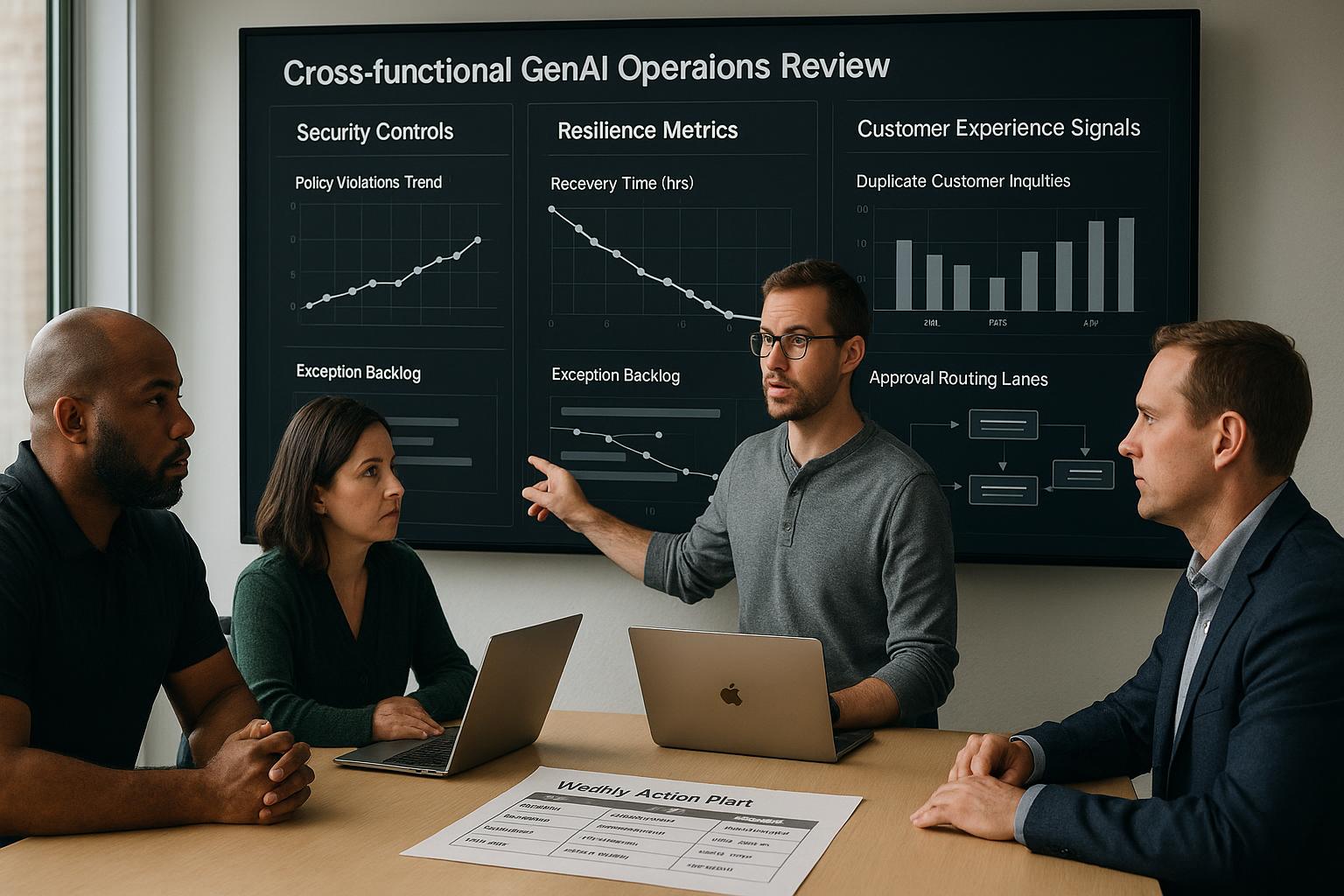
For control: policy violation rate, unresolved high-risk exceptions, and approval-bypass incidence. For resilience: recovery time by failure class, backlog spike containment time, and fallback activation frequency. For customer experience: response clarity score, duplicate inquiry rate, and reopen ratio by request class. Keep metric count low and consistent. Too many metrics reduce decision quality. If a metric does not change behavior, move it to appendix. Core panel should stay decision-ready. Include confidence labels in reporting. If data quality is uncertain due to schema changes or instrumentation gaps, mark it explicitly. Honest confidence labeling builds trust and prevents overreaction to unstable signals.
60-day sequencing model for this priority stack
Days 1-15: implement minimum control boundaries and evidence capture. Freeze policy class rules and approval routes. Days 16-30: harden resilience with fallback paths, alerting, and first incident drill. Days 31-45: optimize customer-facing output structure and role-specific communication patterns. Days 46-60: evaluate expansion readiness through triad metrics and decide scale/stabilize/stop per lane. This sequence allows visible progress without sacrificing safety. It also makes executive expectations realistic: early wins in risk reduction and reliability first, then compounding customer experience improvements as controls stabilize. Teams that follow this cadence usually ship fewer lanes in the first two months but achieve higher sustained value and lower incident burden by quarter end.
Common anti-patterns in GenAI ops prioritization
Anti-pattern one: treating security review as final sign-off instead of continuous operating loop. Fix: weekly control review with owner-assigned actions. Anti-pattern two: assuming resilience equals monitoring dashboards. Fix: define fallback behavior and rehearse incident response regularly. Anti-pattern three: measuring customer experience only through model fluency. Fix: measure clarity, predictability, and follow-up friction. Anti-pattern four: expanding lanes before unresolved exceptions trend down. Fix: enforce expansion gates tied to control and continuity thresholds. Anti-pattern five: letting one team own everything without cross-functional cadence. Fix: role mapping and short recurring governance loops.
How to communicate this priority model to stakeholders
Explain the sequence in plain language: "We secure first so we can scale safely. We harden resilience so we can keep commitments under pressure. We optimize customer experience so value is visible and durable." This framing prevents misunderstandings that security work is "non-delivery" work. Publish short weekly notes with three items: one control improvement, one resilience improvement, and one customer-experience improvement. This makes progress visible even when major feature launches are not happening that week. For executive updates, avoid technical detail overload. Show trend movement, risk posture, and decision requests. Executives need tradeoff clarity and confidence in governance, not internal implementation minutiae.
A practical checklist for your next 10 working days
Day 1: classify lane data by sensitivity and lock policy boundaries. Day 2: assign control, delivery, and CX owners. Day 3: implement minimum approval routes and exception logging. Day 4: define fallback behavior for one critical dependency. Day 5: run a mini incident drill and document gaps. Day 6: update customer-facing output templates for clarity. Day 7: publish triad metric dashboard (control/continuity/confidence). Day 8: hold weekly review and assign top three fixes. Day 9: validate unresolved exception trend and owner load. Day 10: decide scale/stabilize/stop for the lane with documented rationale. If this checklist is incomplete, do not call the lane production-ready. You may have a functioning system, but you do not yet have a reliable operating model.
Executive review template for this priority stack
Use one page with four blocks: control health, continuity health, customer confidence, and next-month decision set. End with three decisions only: one control decision, one resilience decision, and one customer-experience decision. This keeps governance tight and avoids status theater. Close with one plain-language outcome statement, for example: "Policy violations down 42%, recovery time down 31%, duplicate customer follow-ups down 24% after output-template and queue updates." Clear statements maintain sponsorship and keep priorities grounded in outcomes.
Case-style rollout examples by operating context
Case A: internal support desk automation. The team started with policy-safe response drafting and triage recommendations. Security controls blocked sensitive account data from unrestricted generation. Resilience controls added fallback to standard templates when model latency spiked. Customer experience work then focused on clearer status messages and escalation visibility. Result after six weeks: faster first responses and lower duplicate follow-up volume without increased policy exceptions. Case B: client delivery update workflows. Initial issue was inconsistent communication quality across project managers. The lane introduced structured update templates and approval gates for contractual wording. Resilience work prioritized source-precedence logic so summaries did not contradict ticket state. Customer experience optimization focused on predictable update cadence and plain-language milestone framing. Result: higher client confidence and fewer ambiguity-driven escalations. Case C: compliance-heavy operations lane. Here security constraints dominated early design. The team used strict consequence-tier routing with mandatory human approval for high-impact outputs. Resilience improvements added rapid rollback scripts for policy-rule regressions. Customer experience changes were incremental but still meaningful: clearer explanation text for delayed actions due to control checks. Result: slower initial speed but far stronger long-term reliability and audit posture. These examples show the same principle: the sequence remains stable, but emphasis shifts by consequence and context. Security-first is not anti-speed; it is anti-fragility. Resilience-second is not overhead; it is continuity insurance. Customer-experience-third is not delay; it is how value becomes visible and trusted.
Scaling rulebook once the first lane stabilizes
When the first lane passes three consecutive weekly reviews without severe exceptions, you can begin controlled scaling. But scaling should follow a rulebook, not impulse. Rule one: reuse existing controls before inventing new ones. Rule two: validate data-readiness for each new lane before activation. Rule three: assign explicit owners before exposure. Rule four: keep one-lane-at-a-time expansion unless owner capacity is clearly available. A practical expansion scorecard should include control readiness, resilience readiness, and customer-impact readiness. If any dimension is below threshold, classify new lane as prepare-only, not activate. This prevents hidden debt from spreading across portfolio. Also preserve a hard stop condition for every lane. If policy violations or unresolved high-risk exceptions exceed agreed limits, pause expansion and run stabilization sprint. Teams that refuse to pause often lose more time later in incident cleanup and stakeholder trust repair.
Building long-term trust in GenAI operations
Trust is built through predictable behavior over time, not through one impressive release. Operators trust systems that fail safely and recover quickly. Customers trust systems that communicate clearly and keep commitments. Executives trust systems when risk and value are visible in the same reporting frame. To build this trust, keep your operating language simple and repeatable. Every week, answer the same four questions: what improved, what failed, what changed in controls, and what decision is needed now. This rhythm keeps teams aligned and reduces narrative drift. Finally, treat this priority stack as a living system. As your team matures, thresholds and controls will evolve. What should not change is the principle: secure behavior first, resilient continuity second, and customer confidence as the durable proof of value. ---BODY_END--- ===ARTICLE_END===