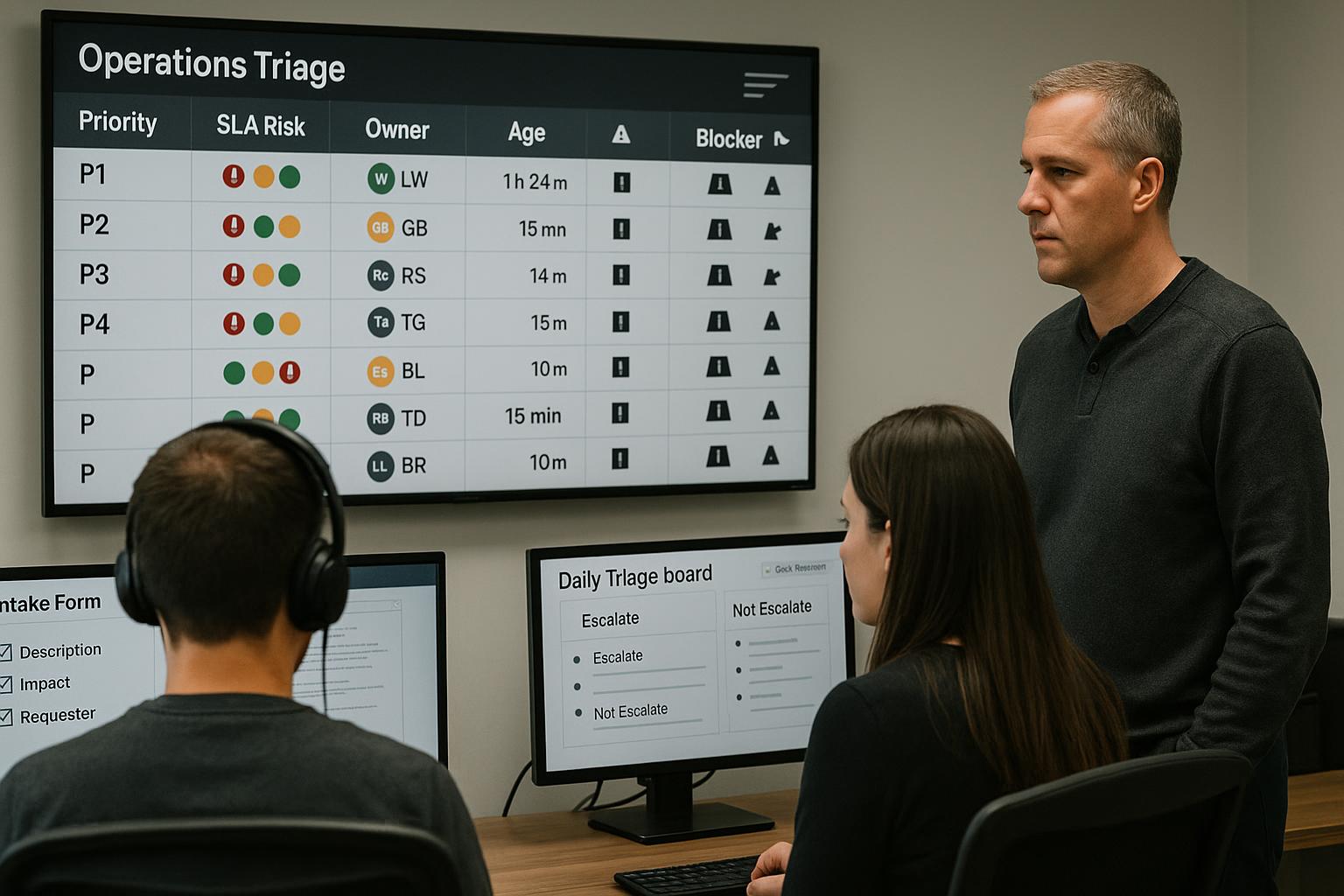
An inbox records arrival order, not business importance. When it becomes the operating queue, work tends to go first to the person who interrupts most often, writes the loudest message, or happens to be known by the team. That is not a prioritisation system; it is an unspoken negotiation repeated all day.
A useful triage queue makes the negotiation visible. It captures a request once, turns it into a defined work item, assigns a provisional class, and makes the next decision clear. The objective is not to eliminate urgency. It is to distinguish a genuine interruption from a request that simply arrived with urgency language attached.
Make the inbox an intake channel, not the queue
Keep the inbox, form, chat channel, or client portal as an intake channel. It is where a request enters, not where it remains. Every request that needs action should become one queue item with a link back to the original message. That avoids two familiar failures: a request disappearing after an acknowledgement, or a team duplicating work because the same issue arrived in several channels.
The first triage action is not “accept” or “reject.” It is clarify enough to decide. A usable item records the requester, the affected service or user, the desired outcome, the consequence of doing nothing, relevant evidence, the claimed deadline and its source, and the person responsible for the next move. A message without those fields may be real, but it is not ready to compete with already-defined work.
Not every message deserves a queue item. Status updates, information-only notes, duplicate requests, and work that belongs to another team should receive a short, explicit disposition. That is more respectful than letting them silently age. For client-facing work, a request-to-completion workflow can make the same status visible to the owner without exposing internal debate.
Define the work item before you prioritise it
Classification is what lets a queue apply different rules to different kinds of work. A security incident, a customer-impacting outage, a standard access request, a discovery question, and an improvement idea should not all be judged with one vague label such as “urgent.” They need different owners, evidence, and escalation paths.
A small operations team can begin with five classes:
- Interruption: a live failure, safety concern, or material customer impact that needs immediate containment.
- Service request: a defined, repeatable request with a known completion path.
- Decision or blocker: work cannot move until a named person chooses, approves, or supplies information.
- Improvement: a known pain point that is valuable but does not yet interrupt current service.
- Discovery: an unclear problem that needs research before anyone can promise a solution.
The categories do not determine priority on their own. They determine what a good next step looks like. Discovery work should be treated as discovery, rather than smuggled into a delivery queue as a vague “quick fix.” That distinction is central to software discovery and protects the team from committing to a solution before it understands the problem.
Create one work item linked to the incoming message, form, or portal request.
Collect outcome, affected user, evidence, deadline source, and the owner of the next decision.
Choose the work class, priority response, and explicit condition for escalation or re-triage.
Start only when capacity exists, then record the outcome, exception, and any policy change needed.
Use a transparent heuristic, not a false-precision score
The next decision is how quickly the queue should respond, not whether a request has value. A simple priority heuristic makes the reasoning inspectable. Use the four signals below in a triage conversation; do not pretend that adding arbitrary points produces an objective answer.
| Signal | Question for triage | Evidence that raises the response priority |
|---|---|---|
| Impact | Who is harmed or blocked if this waits? | Current service failure, a material customer consequence, safety exposure, or a named operational dependency. |
| Time sensitivity | What changes if the work is not addressed soon? | A deadline with a source, a time-bound opportunity, or a condition that will become more costly to contain. |
| Reversibility | Can the effect be corrected later without disproportionate cost or harm? | Irreversible data loss, a compliance event, a customer commitment, or a decision that compounds delay. |
| Commitment and dependency | What other work or person is waiting for this decision? | An agreed contract, a published dependency, or a blocked team with a named next action. |
Use the signals to assign a response class such as “contain now,” “triage in the next review,” “schedule when capacity opens,” or “return for clarification.” The labels should be written in the team’s own language and paired with an owner. Effort is useful for capacity planning, but it is not evidence that a request is more important. A hard, low-impact item can wait; a simple, time-sensitive containment action may not.
Do not automate the heuristic until humans have used it consistently enough to expose its gaps. A scoring rule can make bias less visible while still preserving it. The goal is a better decision record, not a dashboard that can overrule the people accountable for the result.
Set service expectations from observed flow
Service expectations are promises about a system of work, not a number typed into a ticket tool. The 2025 Kanban Guide defines a service level expectation as a forecast based on historical cycle time, with both a time period and a probability. If the team has no history, it can use a provisional expectation, but it should label that as a hypothesis and revisit it after enough comparable work has moved through the queue.
Separate two commitments that are often conflated:
- Response expectation: when someone will classify the request, ask for missing information, or confirm the next decision.
- Resolution forecast: when the work may be completed, subject to dependencies, scope, and capacity.
That distinction protects requesters from silence without asking the team to promise an end date before it understands the work. It also makes escalations clearer: a missed response expectation is a queue health problem; a changed resolution forecast may be a delivery or dependency problem.
Track the minimum flow measures that actually inform a decision: work in progress, work-item age, throughput, and cycle time. The Kanban Guide names these as core flow measures; how a team interprets them remains context-specific. A compact KPI stack for internal systems can keep the dashboard tied to capacity and user value rather than turning every queue into a reporting project.
Run an escalation path that protects people and work
An escalation should be a change in handling, not a louder message. Define a few conditions that can trigger it: a material new impact, an item blocked beyond its agreed review point, missing ownership, a breached response expectation, or a conflict between two legitimate commitments. For each condition, name who can reclassify the item, who makes the next decision, and when the requester receives an update.
For security incidents, the stakes and legal duties may be different from routine operations. NIST’s SP 800-61r3 is specifically a cybersecurity incident-response profile, not a general service-desk standard. Its relevant lesson here is narrower: prepare for cybersecurity incidents and design response and recovery before the event, rather than improvising in the most stressful moment.
Queue overload is also an escalation condition. When the team repeatedly exceeds its agreed WIP control, the answer is rarely to ask everyone to work faster. Pause lower-priority intake, narrow active work, move a decision to the accountable owner, or make the capacity constraint visible. The 2025 Kanban Guide treats explicit WIP control and actively unblocking aging items as parts of managing workflow; it does not prescribe a universal numeric limit.
Review the queue to improve the system
Triage is not finished when the list is sorted. Review the queue at a cadence that matches arrival rate and risk: continuously for genuine interruptions, or at a regular interval for ordinary operational work. Look for the same questions each time: Which items are aging? Where is work blocked? Which request class creates the most clarification? Which “urgent” requests were later reclassified? What policy is producing avoidable work?
Change the intake form, categories, WIP rule, or escalation condition when the evidence says they are not helping. Publish the change in the queue’s operating policy so requesters and team members do not have to rediscover it from behaviour. The enterprise GenAI production playbook uses the same principle in a higher-risk setting: boundaries, explicit owners, evidence, and a controlled change path make a system more dependable than a collection of individual heroics.
- Name a single intake route and create one queue item for every request that needs action.
- Require outcome, affected user, consequence, evidence, deadline source, and next-decision owner before full prioritisation.
- Start with a few explicit request classes and define the correct next step for each one.
- Use impact, time sensitivity, reversibility, and dependencies as visible questions—not an opaque automatic score.
- Set a response expectation separately from a resolution forecast, then revise both using actual flow data.
- Define WIP control, escalation conditions, and the manual fallback when the queue is overloaded.
- Review aged items and classification mistakes, then improve the policy rather than blaming the last person who triaged.
The first version of a priority queue should be deliberately small and easy to correct. Its value is not that it eliminates judgment; it gives judgment a shared record, a visible capacity constraint, and a fairer route for saying “not yet.” Teams that need help turning a scattered request process into an accountable operating system can talk to White Veil Industries.
Sources
- Kanban Guides — The Kanban Guide (May 2025). Used for the definitions of workflow, WIP control, flow metrics, and historically based service level expectations.
- National Institute of Standards and Technology — Incident Response Recommendations and Considerations for Cybersecurity Risk Management: A CSF 2.0 Community Profile (2025). This source applies to cybersecurity incidents; it is cited here only for advance preparation and response/recovery context, not as a general operations standard.
- National Institute of Standards and Technology — The NIST Cybersecurity Framework (CSF) 2.0 (2024). This source is included for the cybersecurity scope/context of the cited NIST material, not as a general-purpose operations SLA model.