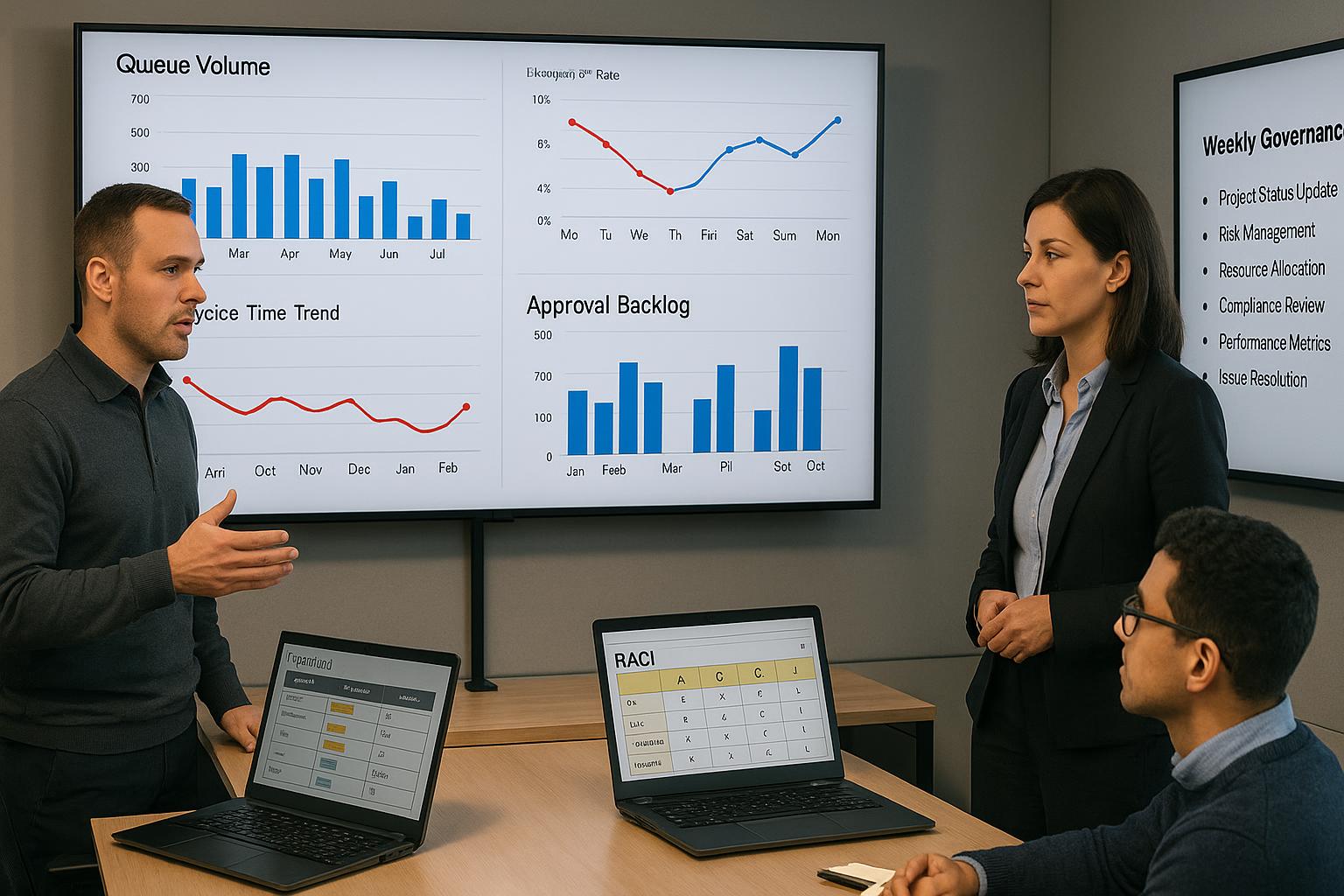
Execution blueprint for teams that need results this quarter
For AI implementation use cases that actually work, your first release should be narrow enough to run within 30 to 45 days, yet meaningful enough to affect a metric leaders already track. This keeps sponsorship active and gives delivery teams space to harden the system before broader exposure.
Implementation detail matters at the interface boundary. Define exactly where data enters, how it is normalized, which fields are mandatory, and how failures are surfaced to users. Vague integration assumptions are a top-three cause of pilot delays.
Document owner decisions in plain language: why this rule exists, when it can be bypassed, and who approves changes. Decision logs reduce institutional memory loss and make onboarding faster when teams rotate responsibilities.
Start with the workflow economics, not the tool catalog
Map the workflow from intake to completion and count where work waits. Delay is usually created by queue ambiguity, manual re-entry, and exception handling that has no clear owner. Each delay point should be measured in hours and in cost of delay, not just in anecdotal frustration.
A reliable baseline has five numbers: volume per week, median cycle time, rework rate, escalation rate, and customer-visible error rate. Without these numbers, any pilot can look successful because there is no denominator. With these numbers, you can defend investment decisions and stop low-value experiments quickly.
In one professional-services team, proposal preparation averaged 14 business days because analysts manually stitched prior language and compliance notes. After introducing retrieval with approved clauses and a guided drafting step, cycle time dropped to 8 days while compliance corrections declined by 37 percent. The visible win came from process design, not model novelty.
Build a delivery lane that survives real operations
A production lane needs explicit boundaries: what the system will automate, what it will recommend, and what must remain human-approved. Teams that skip this boundary design create hidden risk and eventually lose trust when one edge case causes an avoidable incident.
Use staged confidence thresholds. High-confidence low-risk tasks can be auto-completed, medium-confidence tasks should be routed with suggested actions, and low-confidence outputs must be blocked and escalated. This policy structure gives teams speed without pretending uncertainty does not exist.
Treat exception handling as a first-class product requirement. Every exception should capture cause, route, owner, and closure time. Exception data is your fastest path to quality improvement because it reveals where prompts, retrieval, data mapping, or policy assumptions are breaking under operational pressure.
Where value really appears in the first 60 days
When I audit failed AI rollouts, I almost never find a model-quality disaster in week one. I find a planning failure. Teams launch with broad goals, unclear constraints, and no agreement on what "better" means in operational terms. If you want real gains in 60 days, stop chasing novelty and force the team to answer five uncomfortable questions before kickoff: which queue is overloaded, what specific decision is slow or inconsistent, what data source is trusted enough for production, who can approve policy tradeoffs, and what metric would make finance admit the pilot is worth scaling. That discipline sounds basic, but it is the line between a pilot that survives and a pilot that becomes another internal postmortem.
The fastest value usually comes from decision support inside an existing process, not from full automation on day one. For example, proposal teams can cut turnaround time by adding retrieval-backed first drafts, redline suggestions, and compliance hints while still keeping final approval human. Support teams can reduce backlog pressure by giving agents structured summary suggestions, escalation triage recommendations, and response draft scaffolds. Operations teams can reduce handoff loss by normalizing intake fields and auto-classifying request intent before work reaches an owner. In each case, the win is not magical model output. The win is removing repeated manual steps that add no strategic value and consume expensive senior attention.
There is also a hard sequencing rule I use with clients: if your baseline quality is unknown, do not scale access. I have seen teams onboard fifty users to an assistant before they can even quantify override rates, fallback rates, or bad-output classes. That creates noisy feedback and political confusion instead of improvement. Run the first month with a constrained cohort, publish a weekly scorecard, and document every recurring failure mode with owner and due date. Once that rhythm exists, scaling becomes predictable. Without it, scaling multiplies uncertainty and burns credibility with the people who control budget.
How to choose a use case without fooling yourself
Most prioritization meetings are biased toward visibility. The loudest department gets attention, and the most exciting demo gets funded. That is a terrible way to choose an implementation lane. Use a weighted score with four dimensions: business impact, execution complexity, data readiness, and risk class. Impact asks how much throughput, error reduction, or revenue protection is realistically available. Complexity asks how many systems, policy touchpoints, and teams are involved. Data readiness asks whether source quality is sufficient for production decisions. Risk class asks what happens when the system is wrong. A use case can score high on impact and still be a bad first pilot because complexity and risk are too high for a first release cycle.
I recommend one more filter that teams often skip: managerial controllability. If the process owner cannot change workflow rules, update intake schema, or enforce new operating behavior, your pilot will stall regardless of technical quality. AI does not fix organizational indecision. Before selecting a use case, verify that the process owner has explicit authority over policy and exceptions. If not, either reassign ownership or pick a lane where authority is already clear. This one check eliminates months of avoidable delay.
A practical selection workshop can be done in ninety minutes. Bring the process owner, delivery lead, security representative, and one frontline operator. Map current flow on a single page. Mark each step as high, medium, or low friction based on observed delay and rework. Estimate weekly volume and average handling time. Then score two or three candidate interventions with the four-dimension model. End the meeting with one selected lane and one deferred lane. Do not leave with a vague list of possibilities. Clarity at this point is worth more than another week of research.
The operating model: who owns what every week
Strong implementations are boring in the best way: people know exactly what they own. The process owner decides policy boundaries, escalation rules, and SLA tradeoffs. The delivery lead owns release scope, integration reliability, and rollout sequencing. The data owner controls source quality and schema changes. Security and legal define control evidence requirements and approve high-risk actions. Frontline leads validate that recommendations are usable in real workflow pressure, not just in controlled demos. If these responsibilities are fuzzy, incidents trigger finger-pointing and the system degrades quickly.
Create a weekly operating review with fixed inputs and fixed outputs. Inputs: throughput trend, exception taxonomy, top override reasons, unresolved control issues, and user adoption depth by role. Outputs: three changes approved, three changes deferred, and one risk accepted with named owner. Keep the meeting to forty-five minutes. Long meetings encourage storytelling and suppress decisions. The point is not to discuss everything. The point is to keep the system moving with evidence-backed choices and visible accountability.
When a team asks whether this is too much governance for a pilot, my answer is simple: minimal governance is what lets you move faster after month two. Without governance, every issue becomes a special case and delivery slows down. With governance, recurring decisions become templates. After a few cycles, teams stop debating the same topics and focus on meaningful improvements. Speed is a byproduct of disciplined decision architecture, not a substitute for it.
Data contracts that prevent expensive rework
Data quality failure is usually discovered late because teams treat data assumptions as background detail. Do the opposite. Create an explicit data contract for the first workflow. Define required fields, accepted formats, null handling rules, source precedence, and freshness expectations. Define what happens when data violates the contract: block, warn, fallback, or escalate. Then publish these rules where operators can see them. If data rules are hidden in engineering notes, frontline teams cannot diagnose failure behavior and trust collapses.
Also separate informational outputs from action-triggering outputs. If the system is drafting internal working drafts, you can tolerate more uncertainty with clear disclosure. If the system is triggering customer-facing actions, your tolerance must drop and controls must tighten. I still see teams applying one confidence threshold to all outputs. That is a design mistake. Thresholds should be tied to consequence. This simple change reduces both false confidence and unnecessary manual review.
Finally, track schema drift as a first-class operational event. External systems will change field names, optionality, and payload shape. If you are not monitoring drift, one quiet upstream change can degrade performance for days before anyone notices. Add drift alerts and make them visible to both delivery and process owners. The teams that do this recover quickly and maintain trust. The teams that do not end up in reactive firefighting mode, which kills momentum and makes AI look unreliable even when the underlying model is fine.
A concrete rollout example from intake to measurable gain
Consider a mid-size B2B company with fragmented inbound requests across forms, email, and account-manager messages. Before intervention, requests sat in a shared queue with inconsistent categorization and no clear priority logic. Average triage time was twenty-two hours, and high-value opportunities were frequently delayed because the signal was buried in generic traffic. The first implementation step was not AI generation. It was unifying intake schema and enforcing required fields so that requests could be classified consistently.
In week three, the team introduced assisted classification and response recommendations. Confidence policies were strict: high-confidence low-risk classifications auto-tagged, medium-confidence cases routed with recommendations, low-confidence cases blocked for manual review. Every override was captured with reason code. Within four weeks, median triage time dropped to nine hours, while misrouted requests fell by roughly one third. The critical point is that the improvement came from coupled design: intake normalization, policy thresholds, and operator feedback loops. Remove any one of those and the gain would not have held.
By week eight, the team expanded to a second queue and introduced role-specific dashboards. Leadership saw trend stability, process owners saw exception pressure by category, and frontline teams saw recommendation accuracy by request type. Because evidence was visible at each level, adoption rose instead of flattening. This is what "actually works" looks like in practice: scoped rollout, explicit controls, and measurable behavior change tied to business outcomes.
Budget discipline: how to avoid invisible cost creep
Many pilots look successful in productivity terms while quietly creating cost creep in model usage, integration maintenance, and manual review load. Track three cost layers from day one. Layer one is direct runtime cost: token or inference spend by workflow and user role. Layer two is human handling cost: review time, override time, and exception closure effort. Layer three is platform cost: integration upkeep, monitoring, and control evidence preparation. Without all three, your ROI narrative is incomplete and easy to challenge.
Set guardrails before scale. Define a monthly runtime budget per workflow, a maximum acceptable manual-review ratio, and a target exception closure SLA. If one guardrail is breached for two consecutive weeks, pause expansion and run a correction sprint. That policy sounds strict, but it saves money and protects credibility. Expansion should be earned through stable operating performance, not granted because a demo looked good in a steering meeting.
I also recommend a "kill switch with dignity" rule. If a lane fails to meet agreed value thresholds after a defined correction period, close it cleanly and recycle learned assets into the next lane. Teams often keep weak pilots alive for political reasons, which drains resources and blocks better opportunities. Mature programs normalize closure as part of portfolio discipline. Stopping the wrong project is not failure. It is operational competence.
Writing and prompt operations as product work
Prompt quality should be treated like product content, not one-time setup. Version prompts, record change rationale, and tie each revision to observed behavior in production. If a prompt edit improves one metric but worsens another, document the tradeoff explicitly. This prevents silent regressions and helps new team members understand why current behavior exists. Teams that manage prompts as governed assets iterate faster and make fewer repeated mistakes.
Keep language direct and domain-specific. The best operational prompts reference your real intake fields, policy terms, and output format requirements. Generic prompting language creates generic outputs. When output quality drops, do not immediately blame the model. First inspect context retrieval quality, field completeness, and policy conflicts. In most production incidents, prompt text is only one part of the root cause chain.
Finally, pair prompt operations with frontline calibration. Ask operators to label a small sample of outputs weekly with "usable," "needs edit," or "unsafe." This is lightweight, fast, and far more practical than occasional large evaluation exercises. Weekly calibration keeps quality grounded in lived workflow reality and gives delivery teams concrete direction for the next iteration cycle. ---BODY_END--- ===ARTICLE_END===
[Continuing with remaining articles in next response due to length...]