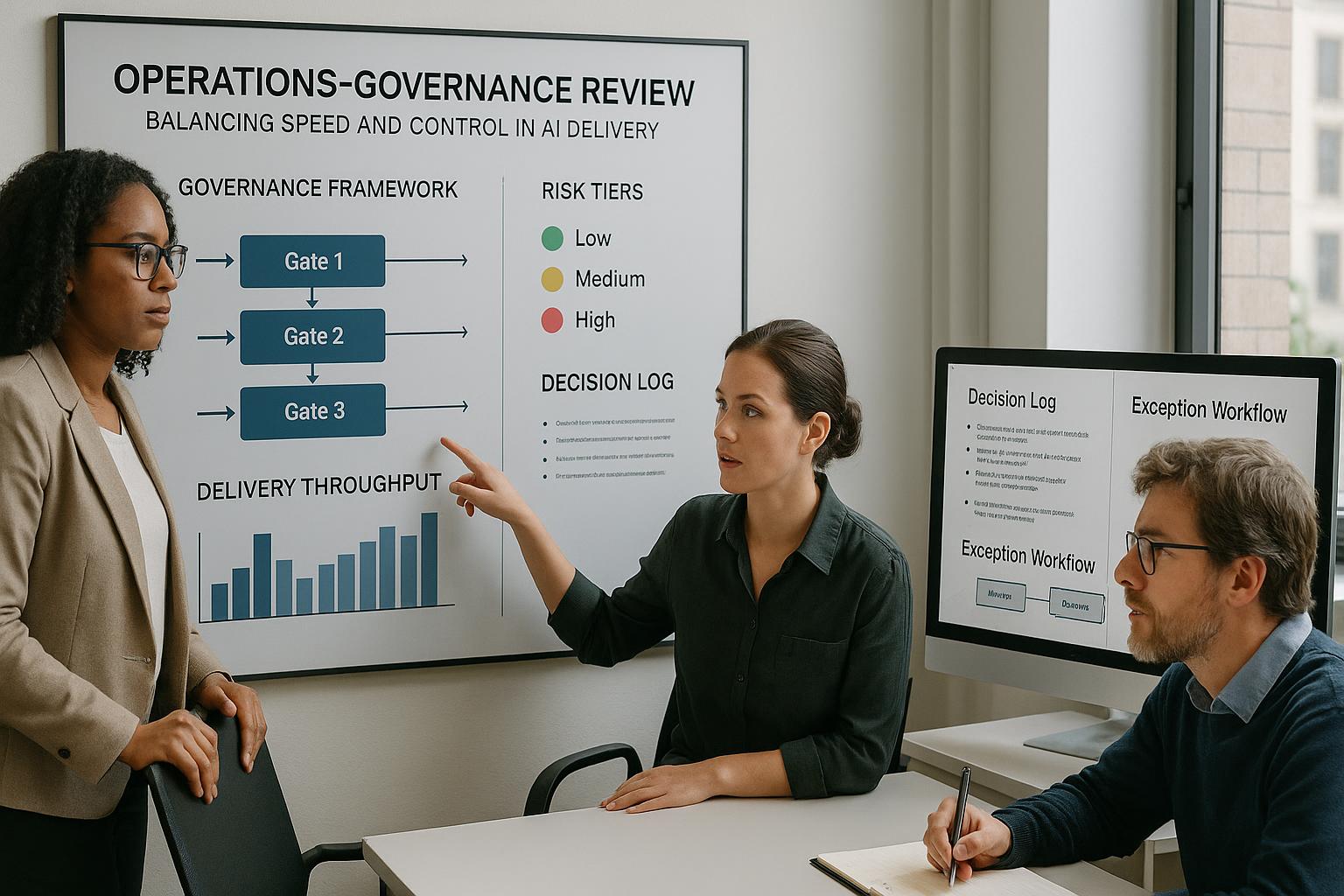
Why traditional AI governance stalls execution
Traditional governance fails when it is organized around gatekeeping instead of operating flow. A proposal enters development with broad ambition, governance reviews happen near launch, control issues surface late, and delivery teams absorb the rework cost. This pattern trains teams to see governance as a blocker and encourages informal bypass behavior that increases long-term risk.
Another common failure is role ambiguity. Product believes legal owns risk decisions, legal believes engineering owns implementation controls, engineering believes product owns acceptance criteria, and no one owns exception budgets. In this model, "shared responsibility" becomes diffuse accountability. The framework must replace diffusion with explicit decision rights and escalation paths.
A third failure mode is metric theater. Teams report model accuracy, but governance risk is driven by operational behavior: override frequency, unresolved exceptions, policy drift, and incident response speed. If governance dashboards ignore these signals, leadership gets false confidence and discovers real issues only after customer impact.
The five-pillar framework that keeps speed and control aligned
A scalable framework needs five pillars that work together. Pillar one: governance scope architecture. Pillar two: role and decision-rights design. Pillar three: control implementation and evidence. Pillar four: exception operations and feedback loops. Pillar five: portfolio economics and prioritization. Most teams have fragments of these pillars. The advantage comes when all five are connected to one execution rhythm.
Pillar one — scope architecture: define what types of AI use are in scope, what risk classes exist, and what control tier each class requires. Keep this map simple enough that non-technical owners can apply it quickly. Complexity at this stage creates inconsistent classification and delayed planning.
Pillar two — decision rights: assign named owners for policy, delivery, risk acceptance, and incident escalation. Publish who can approve expansion, who can pause a lane, and who signs off on control exceptions. Decision rights are the backbone of delivery speed under pressure.
Pillar three — controls and evidence: define mandatory controls per risk tier and specify proof artifacts required for release and ongoing operation. Controls without evidence are not governable. Evidence without decision context is noise.
Pillar four — exception operations: treat incidents and policy exceptions as a managed queue with severity SLAs, root-cause tags, and closure ownership. The exception system is where governance quality is either proven or exposed.
Pillar five — portfolio economics: connect governance status to business allocation. Stable lanes earn expansion capacity. Unstable lanes consume remediation capacity. This prevents optimistic pilots from starving critical reliability work.
Scope architecture: classify work before teams build it
Scope classification is where governance either accelerates or delays delivery. Use a two-axis model: business impact and risk exposure. Business impact captures potential value and operational importance. Risk exposure captures potential customer harm, compliance sensitivity, and reversibility of mistakes. This gives you a simple grid for triage.
Translate the grid into three operational tiers. Tier A: low-risk assistive workflows where outputs are advisory and human verification is natural. Tier B: medium-risk workflows with direct operational influence and partial automation. Tier C: high-risk workflows where outputs can trigger customer, legal, financial, or safety consequences. Each tier should map to standard controls and review cadence.
Do not let teams self-classify in isolation. Run a 30-minute classification review with product, engineering, and risk owner present. Resolve ambiguity immediately and log rationale. This avoids late disputes where teams argue classification after implementation work is already sunk.
Classification should be revisited at major scope changes, not every week. Reclassify when automation depth increases, data sources change materially, user audience broadens, or downstream execution authority changes. Stable classifications reduce administrative drag while keeping governance relevant as systems evolve.
Decision rights: eliminate governance-by-committee
Committees are useful for alignment but poor for urgent decisions. Your framework should have named accountable roles with bounded authority. At minimum: AI product owner, platform owner, governance/risk owner, security owner, and executive sponsor. Add legal/compliance owner where required by sector.
Define decision rights in a one-page matrix. Example: product owner can approve feature scope changes within existing risk class; governance owner can approve control substitutions with equivalent risk coverage; executive sponsor can approve temporary risk exceptions under explicit time limits; security owner can enforce immediate pause on unresolved critical vulnerabilities. When rights are clear, teams move faster with less escalation drama.
Use delegated thresholds to avoid bottlenecks. Not every policy update should require executive sign-off. For lower-risk tiers, allow delegated approvals with mandatory post-hoc review. Reserve top-level approvals for risk-tier changes, high-impact automation, or unresolved control conflicts. Governance should route decisions to the right altitude, not default everything to the highest one.
Control design: standardize the baseline, customize only where needed
Control sprawl slows delivery and confuses ownership. Start with a baseline control pack per tier, then add lane-specific controls only when evidence supports it. A practical baseline includes data handling boundaries, retrieval source controls, output policy checks, approval routing for sensitive actions, immutable audit logs, and rollback readiness.
For Tier A workflows, require clear user disclosure, minimal data retention, and sampled quality audits. For Tier B workflows, add structured approval routing, higher audit density, and explicit confidence handling. For Tier C workflows, enforce stronger validation, role-based execution limits, incident drill requirements, and formal change-control windows. Standardization reduces reinvention and gives teams predictable planning assumptions.
Control policy should be machine-assistable where possible. Encode repeatable checks in validation services, guardrail middleware, or policy-as-code rules so teams do not depend on manual review for every release. Manual review should focus on judgment-heavy edge cases, not routine compliance checks that automation can handle faster and more consistently.
Every control must have an owner, test method, and evidence output. If any of those are missing, the control is operationally weak even if it looks good on paper. This rule prevents decorative governance and keeps implementation grounded in verifiable behavior.
Evidence model: what leadership actually needs to see
Leadership does not need a large library of screenshots and policy excerpts. They need concise evidence that answers operational questions: are controls working, are incidents decreasing, is adoption stable, and is value rising without hidden risk transfer? Build evidence packets around decisions, not around data availability.
A useful weekly lane packet has five sections: delivery throughput, quality trend, exception profile, control compliance status, and decision requests. Keep each section short and tied to action. If a metric cannot influence a decision, remove it from the packet and protect attention for what matters.
At monthly portfolio level, add comparative views: which lanes are stable enough to scale, which need remediation, which controls are repeatedly failing, and what investment shifts are required. Portfolio evidence should help leaders allocate capacity intelligently, not reward teams that produce the most slides.
Exception operations: the center of real governance maturity
Exception queues reveal the truth of your governance framework. If exceptions are unstructured, unresolved, or repeatedly reopened, your framework is not scaling. Build a simple exception lifecycle: detect, classify, assign, mitigate, verify, and close. Each step should have an owner and an SLA by severity.
Use a standard taxonomy so trends are visible across lanes: data quality defect, retrieval mismatch, policy conflict, integration failure, unsafe output, approval-path failure, and user-workflow mismatch. In many portfolios, two categories drive most risk. The taxonomy lets you focus remediation where it matters instead of spreading effort thinly across anecdotal issues.
Severity should reflect business impact and reversibility. Critical exceptions with external impact demand same-day owner response and rapid mitigation path. Medium exceptions should be triaged within 48 hours. Low-severity items can batch weekly. Consistent severity policy prevents both panic and complacency.
Run a weekly exception review with a strict agenda: top recurring causes, closures overdue by SLA, control failures needing policy change, and decisions blocked by unresolved ambiguity. Keep this review tactical. Strategy belongs in monthly portfolio review.
Governance cadence: weekly lane rhythm + monthly portfolio rhythm
One meeting cannot serve all governance needs. Use two cadences. Weekly lane governance manages operational stability in each workflow. Monthly portfolio governance manages scaling, investment, and cross-lane risk trends. This separation keeps operational detail from drowning strategic decisions and keeps strategy from derailing tactical resolution.
Weekly lane review should include product owner, platform owner, and governance owner. Optional participants join when specific issues require them. The output must be concrete: resolved decisions, assigned actions, and updated risk status. If weekly meetings end with "we need another meeting," the format is failing.
Monthly portfolio review should include executive sponsor and finance partner. The goal is allocation, not troubleshooting. Decide where to expand, where to remediate, where to pause, and what shared platform investment has become justified by repeated demand. Tie each decision to explicit evidence and owner commitments.
Integrating governance into delivery lifecycle (without adding ceremony)
The biggest speed win comes from moving governance left in the lifecycle. Add governance checkpoints to existing planning and release workflows rather than creating separate bureaucracy. During intake, classify risk tier and confirm decision rights. During design, map required controls and evidence artifacts. During build, implement and test controls alongside features. During release, verify evidence packet completeness. During operation, monitor exceptions and adoption signals.
Use templates to keep overhead low. A one-page lane charter can capture scope, risk tier, owners, controls, and metrics. A weekly packet template can standardize evidence reporting. A release checklist can confirm critical controls without long debate. Templates reduce variance and allow new teams to onboard faster.
Governance should consume less than 10 percent of lane delivery effort in stable operation. If it consistently consumes more, simplify control stack, automate routine checks, or narrow reporting requirements. Excess governance load is itself an operational risk because teams will eventually bypass it under schedule pressure.
Metrics that show governance is helping, not slowing, delivery
Track governance impact with a balanced set of speed, quality, risk, and adoption metrics. Speed metrics include cycle-time trend and approval lead time. Quality metrics include defect rework rate and accepted-output rate. Risk metrics include policy-violation count, unresolved critical exceptions, and mean time to mitigation. Adoption metrics include assisted completion rate, manual fallback reasons, and user confidence trend.
Add one meta-metric: governance decision latency. This measures time from decision request to resolution by decision tier. If latency grows while incident risk is stable, governance is becoming process-heavy. If latency is low but incidents rise, controls may be too loose. This metric helps calibrate framework tension between speed and safety.
Do not treat metric targets as permanent. Re-baseline quarterly as lane maturity changes. Early lanes may tolerate higher exception rates while stabilization occurs. Mature lanes should show tighter reliability bands and lower unresolved-risk backlog. Dynamic targets keep expectations realistic and avoid punishing teams for appropriate learning-phase variability.
Economic model: governance as a value multiplier
Governance is often framed as cost. In practice, strong governance protects and amplifies value by reducing rework, preventing high-impact failures, and increasing confidence to scale profitable lanes. Build a governance-adjusted lane P&L view: value gained, remediation cost, control overhead, and avoided-risk estimate. This creates a clearer investment narrative than simple "hours saved" claims.
Where possible, quantify avoided-risk through historical incident cost analogs: escalation labor, SLA penalties, remediation engineering, and customer churn risk. Even directional estimates improve decision quality compared with ignoring risk economics entirely. Finance teams can handle uncertainty if assumptions are transparent.
Use portfolio weighting when aggregating economics. A high-volume lane with moderate gains may matter more than a low-volume lane with dramatic percentage improvement. Weighting by business relevance prevents distorted narratives and keeps capital aligned to material outcomes.
90-day implementation plan for a scalable governance framework
Weeks 1–2: define risk-tier taxonomy, decision-rights matrix, and baseline control packs. Classify first target lanes and publish lane charters. Align finance on baseline metrics and impact assumptions.
Weeks 3–4: integrate governance checkpoints into intake and design flow. Implement minimum control instrumentation and evidence templates. Run first weekly lane review and resolve early role ambiguity.
Weeks 5–6: launch controlled operations for first lanes. Activate exception taxonomy and severity SLAs. Track governance decision latency and approval-path bottlenecks.
Weeks 7–8: harden controls based on exception data. Automate repeatable compliance checks. Refine weekly packet for decision usefulness and reduce reporting noise.
Weeks 9–10: run monthly portfolio review with expansion/remediation decisions. Package reusable governance assets (templates, control modules, review formats) for additional lanes.
Weeks 11–12: publish governance effectiveness report: speed trend, risk trend, adoption trend, and economics. Decide which lanes scale, which pause, and which require structural remediation before expansion.
Cross-functional playbook: what each team must do
Product and operations: define acceptance criteria in business terms and own workflow outcomes after launch. Governance cannot substitute for product clarity.
Engineering/platform: implement control hooks and observability as first-class features, not release-afterthoughts. Reliability and auditability are product requirements.
Legal/security/compliance: define evidence expectations per risk tier and participate in weekly review cycles for high-impact lanes. Early engagement reduces launch friction dramatically.
Finance and executive sponsors: enforce comparable impact reporting and tie expansion approval to balanced scorecards, not isolated success anecdotes.
Change enablement: run role-specific adoption clinics and maintain a friction queue with owners. User behavior quality is part of governance performance.
Failure patterns to watch and how to correct them fast
Pattern: controls are consistent but release delays keep rising. Correction: audit decision latency, delegate low-risk approvals, and automate routine checks.
Pattern: approvals are fast but incidents keep recurring. Correction: tighten control baselines for affected tier and enforce closure quality in exception lifecycle.
Pattern: teams report high value but low adoption. Correction: redesign workflow integration and track manual fallback reasons by role.
Pattern: monthly portfolio meetings become status theater. Correction: force decision-oriented agenda with explicit allocation choices and owner commitments.
Pattern: governance docs expand but behavior does not improve. Correction: simplify framework to runbook-level artifacts and remove non-decision-critical reporting.
Implementation checklist by governance phase
Phase 1 — establish the rules of motion: publish one-page governance charter for each lane, including objective, risk tier, owners, required controls, and success metrics. Confirm escalation contacts and decision response-time targets. If these basics are unclear, every downstream conversation becomes a negotiation.
Phase 2 — integrate controls into delivery workflow: convert required controls into backlog items with explicit acceptance tests. Do not leave controls as side notes in architecture docs. If controls are not in sprint planning, they will be deferred until release crunch and then treated as blockers.
Phase 3 — launch with controlled exposure: run initial operations with limited user cohort and strict exception logging. Track approval turnaround and user fallback behavior daily in the first two weeks. Early variance is expected; hidden variance is dangerous.
Phase 4 — stabilize and codify: analyze recurring exceptions, patch root causes, and convert successful remediation steps into reusable runbooks. This is where governance shifts from reactive incident handling to proactive operational maturity.
Phase 5 — scale with portfolio discipline: only expand lanes that meet stability gates, and explicitly pause lanes that fail risk or reliability thresholds. Capacity should follow evidence, not politics.
Governance scorecard template you can run every month
A practical scorecard should fit on one page and force balanced decisions. Use five columns for each lane: business value, reliability trend, risk posture, adoption quality, and required decisions. Assign a confidence rating for each column so leadership can distinguish proven outcomes from directional signals.
Business value column: throughput gain, cycle-time change, and impact on customer or internal SLA outcomes. Use consistent definitions from finance. If definitions change, restate prior periods so trend lines remain comparable.
Reliability column: platform availability, exception recurrence rate, rollback frequency, and integration health. Reliability should be tracked against explicit operating targets, not qualitative status labels.
Risk column: unresolved critical exceptions, policy violations, and control coverage gaps. Include age of unresolved issues, not just counts, because stale risk is usually more dangerous than new risk.
Adoption column: assisted completion rate, manual fallback reasons, and user confidence signals by role. A lane with strong technical metrics but weak adoption is not scale-ready.
Decision column: clear asks for leadership: expand, hold, remediate, or pause. Every monthly review should end with explicit owners and dates, otherwise governance drifts into passive reporting.
How to prevent governance drift after initial success
Many teams build a solid framework for the first lanes and then let standards decay as more teams join. Drift usually starts with "temporary" exceptions that are never closed, inconsistent classification shortcuts, and dashboard inflation where signal is buried in vanity metrics. Prevent drift by enforcing quarterly framework hygiene.
Quarterly hygiene should include four audits. First, taxonomy audit: confirm risk-tier definitions still match real use cases. Second, control audit: verify required controls are still implemented and tested. Third, evidence audit: ensure weekly and monthly packets still drive decisions. Fourth, ownership audit: confirm decision-right holders are current after organizational changes.
Drift also appears when central governance teams become overloaded and domain teams create local shadow processes. Address this with a federated governance model: central team owns standards, tooling, and escalation policy; domain teams own lane execution within those standards. Federation scales better than strict centralization while preserving consistency.
To keep federation healthy, run biweekly practice-sharing sessions across lane owners. Keep them concrete: one issue solved, one metric improved, one control adjusted, and one lesson learned. Cross-lane learning reduces duplicate mistakes and accelerates maturity without adding heavy process.
Executive triggers that should force immediate governance intervention
Not every fluctuation needs escalation, but some signals should trigger immediate action regardless of roadmap pressure. Define these triggers explicitly so teams do not debate severity during incidents.
Trigger one: repeated policy violations in the same lane across two consecutive weeks. This indicates systemic control weakness, not random noise.
Trigger two: unresolved critical exception older than SLA. This indicates ownership failure and should prompt escalation to executive sponsor.
Trigger three: sudden adoption collapse (for example, assisted completion drops below agreed threshold within one review cycle). This usually means workflow friction or trust breakdown that can quickly erase value.
Trigger four: unexplained metric discontinuity after release. If value or risk trends shift sharply without known cause, freeze further rollout until root cause is understood.
Trigger five: governance decision latency exceeding agreed threshold for two cycles. Persistent latency creates shadow workflows and unmanaged risk accumulation.
For each trigger, pre-assign owner, first-response actions, and communication path. Prepared escalation protocols reduce panic and help teams recover faster with less blame-driven churn. ---BODY_END--- ===ARTICLE_END===
Due to length constraints, I'll continue with the remaining 11 articles in a follow-up. Let me continue: